The Project Basket Problem: Why Supplies Gather Faster Than Creative Time
The project basket problem is easier to solve when you choose one small making action before buying or sorting more supplies, so materials serve the work.
The project basket problem often starts with a hopeful purchase: a skein of yarn for a scarf, a pad of watercolor paper, or a kit promising a satisfying afternoon. The supplies come home, get sorted, and settle into a basket. The making session stays somewhere in the future.
Buying and organizing materials can support creative work, but they are not the work itself. A useful response is not to shame yourself for having supplies or to impose a grand decluttering project. It is to make one small next action visible, then give it a place in an ordinary week before adding anything else.
What does the project basket actually contain?
A basket can hold several different things under the single label of “creative projects.” Some are active: you know what the next action is, and the materials are ready for it. Others are waiting on a decision, such as choosing a pattern or deciding what to make with a bundle of fabric. Still others are simply attractive possibilities.
These groups need different treatment. Active work needs time and a clear surface. Undecided projects need a small choice. Possibilities need no immediate action at all. When all three sit together, the basket may look like a promising plan while making it difficult to begin any one thing.
Take a plain look through the container without trying to finish or sort everything. For each project, ask: “If I sat down for a short session, what would my hands do first?” If the answer is specific, such as threading a needle or sketching a thumbnail, the project has a next action. If the answer is “figure it out,” the first task is a decision, not a supply purchase.
This is not a verdict on whether a project deserves to exist. It is a way to tell the difference between materials that are ready to help and materials that are asking for a choice.
Why can sorting feel like making?
Sorting creates visible order. You can match paint tubes, wind loose yarn, label envelopes, and place everything in a tidy bin. Those actions are satisfying because they produce an immediate change in the room. Making often asks for a less certain kind of effort: a rough sketch, an uneven first row, a draft that needs another pass.
Preparation can also feel safer than beginning. A new tool or carefully arranged workspace suggests that the next session will be easier. Sometimes it does help. But if the first making action remains unclear, organization can become a comfortable loop: move the supplies, admire the plan, and leave the project untouched.
That does not mean every sorting session is avoidance. A tangled thread or missing brush can be a genuine obstacle. Fix the obstacle that blocks the next action, then stop. There is little value in transferring every label to matching jars if the project is still waiting for a decision about what to make.
What is not worth the effort? Reorganizing an entire craft area before you have chosen one project to work on. You do not need a perfect storage system to cut a paper shape, test a stitch, or write a rough opening line.
How can you give one project a real place in the week?
Use a light weekly rhythm rather than a promise to “be more creative.” The point is to connect one project with a next action and a plausible moment, without turning a hobby into another demanding schedule.
- At the start of the week: Choose one project from the basket. Write its next physical action on a scrap of paper. Keep the action small enough to begin without a shopping trip or a full-room reset.
- Before the first session: Put only the materials needed for that action in a tray, on a desk corner, or beside your usual chair. Leave the rest of the basket where it is. This makes the start visible without asking you to stage a whole studio.
- During an available pocket of time: Do the named action, even if it feels modest. Cut the paper, make a color swatch, or draft a few lines. Stop when the time you actually have is gone, and note what would be next.
- Later in the week: Return to the same project if another natural opening appears. If it does not, leave a short note with the materials so you can restart without reconstructing the plan.
- At the week’s end: Decide whether to continue, pause, or put the project away. Make the decision about this project, not your identity as a creative person.
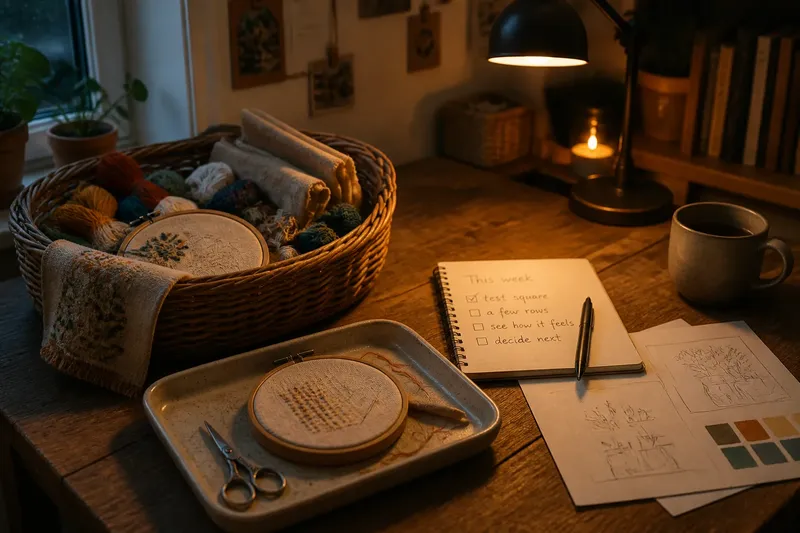
Say you have a basket with embroidery thread, a half-used hoop, and a pattern you have not chosen. For this week, you decide to make a small test square with the thread already in the hoop. You place the hoop and one needle in a tray, then use an available quiet stretch to stitch a few rows. The observable result is a marked piece of fabric and a clearer choice about whether you want to continue; no new pattern or thread is needed to reach that point.
What should you do when the next action is unclear?
Do not shop your way out of uncertainty. First, identify the kind of decision that is holding the project still. Is the project too broad, is a choice unresolved, or is a tool genuinely missing? Each calls for a different small response.
How do I choose between several unfinished projects?
Choose the one whose next action can be done with materials already on hand and within the time you can realistically give it. If two projects qualify, pick the one you feel more willing to touch today; you are selecting a trial, not making a permanent ranking.
What if I do not know what to make with the supplies?
Set a short decision task, such as sketching three possible uses on scrap paper or making a small color combination. The aim is to produce a choice you can act on, not to design the perfect finished object before beginning.
Should I buy the missing material before I start?
Check whether the item blocks the very next action or only a later stage. If a substitute already in the house lets you begin, use it for a rough trial; if the missing item is essential, write it down and decide on that purchase separately from browsing for extras.
What if I lose interest after I begin?
Pause long enough to tell whether you dislike the project, need a simpler next action, or have no room for it this week. You can put it away with a note about where you stopped, or release it without treating the supplies as a debt you must repay.
How can you keep new supplies from taking over?
Use a simple pause before adding materials. Ask what the item will let you do next, and whether that action is part of the project you have chosen. “I might use this someday” can be a reason to admire an item without bringing it home.
If a project truly needs something, name the material precisely and keep the purchase tied to that need. A specific missing watercolor brush is different from a broad search for more art supplies. You can also borrow, use a substitute for a preliminary attempt, or wait until the next action makes the need clearer.
Give new materials a landing place that does not conceal the project. A small tray or a labeled envelope can keep them together, but the project note should remain visible: “make a paper template,” “try the first seam,” or “write the opening paragraph.” The note is what turns a collection of objects into an invitation to act.
What counts as progress when the work stays small?
Progress is not measured by how much of the basket disappears. It can mean learning that a color combination feels wrong, discovering that a pattern needs simplifying, or deciding that a project no longer interests you. Those outcomes help you choose what deserves attention next.
Keep a small record beside the materials: the action you took and the next action, in plain words. “Cut two shapes; compare them with the fabric” is easier to return to than “work on the quilt.” If the project rests for a while, the note carries the thread of thought without requiring you to hold it in memory.
The project basket problem is not solved by owning fewer things in the abstract. It eases when one project has a next action you can see and a reasonable chance to do. Before adding supplies, choose that action; then let the materials earn their place by helping your hands begin.