How to Keep Mementos Without Keeping Every Scrap
Use a simple memento system to sort keepsakes, add useful labels, and revisit their meaning so the objects that matter have a clear place at home.
A ticket stub slips from an old book, and you pause before dropping it in the recycling. A simple memento system can help you decide what to keep, record the story, and make room for the objects you still value.
What makes a memento worth keeping?
Start with the object’s role in your life now. A letter might preserve someone’s handwriting, a child’s drawing might mark a particular stage, and a concert program might bring back a friendship. The item does not need to be old or useful to others; it needs a meaning you want to retain.
Ask yourself three plain questions: What does this remind me of? Is there a detail I would lose if I let it go? Would a photograph or a short note preserve that detail just as well?
Keep the physical object when its material features matter, such as handwriting, texture, or a small mark that carries the memory. If its meaning is mainly visual, a photograph with a caption may be enough. You can also keep one representative piece from a larger group rather than every related scrap.
How do you sort keepsakes without getting stuck?
Gather a small group of items on a clear table. Set out three destinations: keep, record and release, and decide later. The last category is a temporary holding place, not a reason to postpone every choice indefinitely.
- Check what the item is. If you can identify it and its connection, move to the next decision; if not, place it with items from the same source and look for clues before deciding.
- Check whether it holds information you cannot replace. If it does, keep it or make a readable copy; if it does not, consider whether its emotional meaning still merits space.
- Check whether the physical form matters. If handwriting, texture, or wear is part of the memory, keep the object; if a picture preserves what matters, photograph it and release the original.
- Check whether the object has a clear place. If it fits with related letters or photographs, store it there; if it has no suitable home, choose a smaller representative item or record the story instead.
- Check whether someone else is connected to it. If another person may have important context or a claim to the item, ask them before letting it go; if not, make your own decision.
- Check whether you are ready to decide. If you can explain what you want to preserve, choose keep or record and release; if you remain uncertain, write down the question and set a specific date to revisit it.
Say you find a postcard, a folded map, and several receipts from a trip. You recognize the postcard as a message from your friend, but the map has no notes and the receipts only show routine purchases. You write the friend’s name, the destination, and the trip’s connection on the postcard’s sleeve, then place it with related photographs. You photograph the map beside the postcard in case its markings help recall the route, and recycle the receipts after confirming they hold no needed records. The result is a labeled keepsake, a visual record of the map, and less paper to store; if the map’s handwriting or markings prove meaningful to you, keep it with the postcard instead.
What should a useful memento label say?
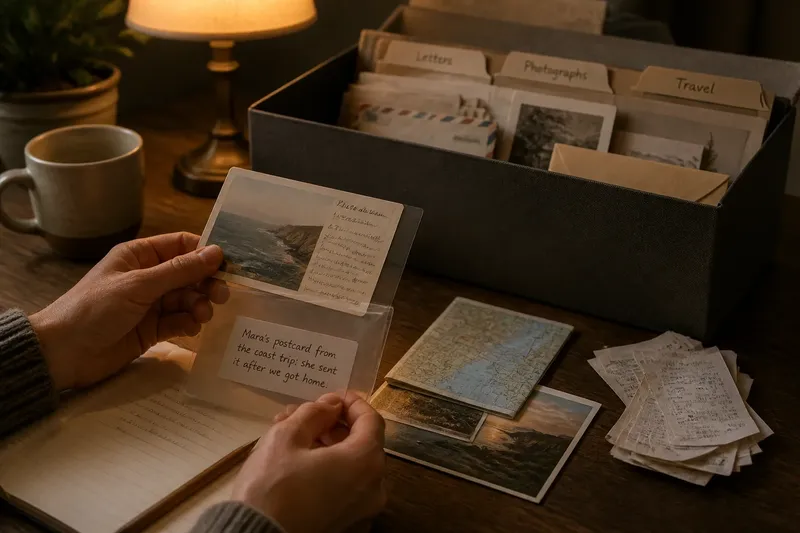
Write the context that future-you might not remember. A compact caption can include the people, place, occasion, and reason you kept the item. Use a pencil on an archival folder or a separate note; avoid putting adhesive labels directly on fragile paper or photographs.
For example, “Mara’s postcard from the coast trip; she sent it after we got home” is more helpful than “Postcard.” For a family recipe, note who used it and what meal it was associated with. Keep the language plain. A label is a memory aid, not a polished family history.
Store the note with the item so the context does not become separated. If several people remember an event differently, record their names beside their accounts rather than forcing one shared version.
How often should you revisit a keepsake box?
Choose a natural moment, such as when you add an item, move homes, or make space in a drawer. Revisit only the pieces that need attention; there is no need to reopen every box on a fixed schedule.
For each item you revisit, read its label and ask whether the object still serves the purpose you recorded. If the context is missing, add it. If the object no longer matters but the story does, make a brief note or photograph before releasing it. If you still value the physical item, return it to its assigned place.
Do not spend an afternoon building a perfect catalog for every small keepsake. A clear label and a simple home are usually more useful than an elaborate inventory you will not maintain.
How should you store delicate paper keepsakes?
Keep paper in a clean, dry place away from direct sunlight. Use a folder or box that lets the item lie flat, and separate papers that could stain, snag, or transfer ink. Handle brittle or historically significant material gently rather than trying to repair it with household tape or glue.
If an item is valuable, fragile, or important to several family members, ask a qualified conservator or archivist for advice before attempting repairs or changing its storage. For ordinary keepsakes, a simple folder, a separate caption, and a consistent shelf or drawer are often enough.
Which keepsake questions come up most often?
Should I keep an object or a photograph of it?
Keep the object if its physical qualities carry the memory. Choose a photograph with a caption when the visual record is enough or the item takes more space than its meaning warrants.
What if I cannot remember where an item came from?
Look for clues in nearby letters, photographs, or family notes, and ask anyone who may recognize it. If the story remains unknown, decide whether the object itself matters to you; otherwise, record what you do know before letting it go.
Can I keep a memory without keeping every related item?
Yes. Select one representative object, photograph a group together, or write a short account of the event. Keep the details that matter to you rather than treating every scrap as equally important.
Where should I put a keepsake after labeling it?
Store it with related items in a clean, dry place away from direct light. Use a folder or box that protects the item without bending it, and keep its label or note alongside it.
How can you make a memento decision today?
Choose one small group and decide what you want to preserve: the object, the information, or the story. Add a brief caption, give anything you keep a clear home, and set aside only the genuinely uncertain pieces for a dated revisit. This simple memento system keeps the meaning accessible without asking your shelves to hold every trace of the past.